


Repetition
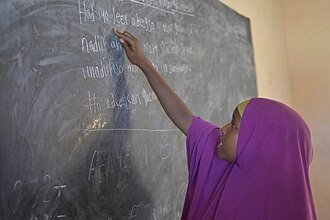
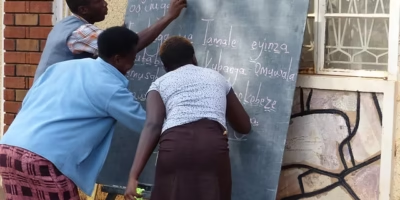
At Level 1, the lesson begins with the participants going to the chalkboard and writing down the letters they learned in previous lessons. This activates the group and helps them remember what they have already learned.
STEP 1: Theme text
The text describes an everyday situation without providing solutions or values.
At level 1, the group leader writes the theme text on the chalkboard while the participants are watching. Then the group leader reads the text and the participants read after. The theme text is also printed in the participants' booklets.
Examples of theme texts are: “ Mary's baby had diarrhea for four days before he died. "Or" Tamale's wedding may never take place because his fiancee wants him to first test himself for HIV. "
At level 2, participants read the text directly in their booklets. In addition to the description of a life situation, the text also contains a numeracy problem. A typical level 2 text might be: “ Jane's mother sent her to the market to buy nine eggs. On the way home she started playing with some other children and had broke four eggs. When she got home she got a lot of punch." The numeracy problem hidden in the text is 9 - 4 = 5.
At level 3, the texts are longer, and more varied. They can be instructions on how to do something, argumentative or explanatory texts, letters and dialogues or literary texts, like folk tales.
STEP 2: A new letter or numeracy problem
In this step at level 1, the group leader writes a word from the theme text below the text. The word contains the new letter to learn. Under the word, the group leader writes the new letter.
Participants learn the letter and the sound it represents. They underline the letter wherever it appears in the text. Then they underline any other letters that they have learnt in previous lessons. After a few lessons, they find words in which all letters are underlined. They begin to read whole words, and eventually the whole text.
At level 2, a numeracy problem is found in the theme text and the participants learn how to solve it. They then practice solving similar problems.
STEP 3: Writing Exercise
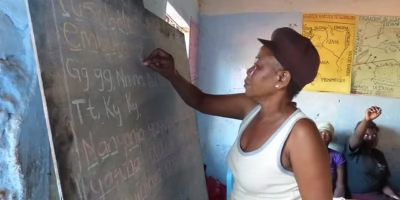
At level 1, the group leader shows how to write the new letter. They first practice writing it in the air. Then the participants write in their notebooks. After some lessons they can write whole words, later whole sentences. Towards the end of the course, they write sentences where they express their own thoughts.
In step 3 in level 2, participants practice solving numeracy problems similar to the one presented in the theme text. First they work together on the chalkboard, then individually in the notebooks.
STEP 4: Group Discussion
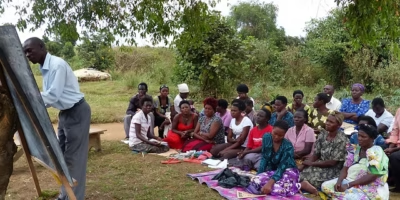
At all levels, the group discusses the situation described in the theme text. The discussion is based on three questions:
- Do you have similar experiences? - sharing one'sown experiences and feelings.
- Why is it like this? - analyzing one's living conditions together.
- What can we do about it? - common decisions are made to act.
The group leader encourages everyone to participate actively. No opinions or thoughts are considered “wrong”. Nor does the group leader tell the participants what they should do or think. The discussions conclude with the group making joint decisions about how they intend to act.

STEP 5: Creating texts
In this step articipants create a text around what they have discussed. In level1, the participants dictate to the group leader who writes on the chalkboard. When the text is complete, the whole group reads the text together while the group leader points to the words.
In level 1 the participants then underline all the letters they have learned. They look for words in which all letters are underlined and read them aloud. Finally, they read the text together several times. After about half the course, many can read the entire text without help.
At level 2, the groups either create a text together on the chalkboard as in level 1 or write a short text themselves in their notebooks. The texts are read aloud several times as a reading exercise.
In level 3 participants create longer texts together or in groups. The best texts are printed and laminated and placed on message boards in the villages. Many passers-by read and talk about the texts. On this level they also work on creating documents to be used in an association or a cooperative, e.g. statutes, application for registration, cash book and minutes.
STEP 6: Numbers and a second language
In this step in Level 1 groups learn to read and write numbers, usually up to 1000. They also learn to read and write dates. It is important for parents to be able to read their children's date of birth on various documents, and also to read the date of expiry on medicine packages. Phone numbers are another important application of numbers.
At level 2, the group begins to learn a second language, usually the country's official language. Usually they start with easy interactive conversation exercises.
At level 3, groups continue to work with reading and writing in a second language. They learn to read documents that they encounter in everyday life, and to fill in different forms, to orient themselves with the help of signs and notices. At this level, they also continue to apply numeracy, often with the focus on running a business or an economic association.